Showing posts with label Jewish Historical Museum. Show all posts

Amsterdam Museum Cannonball Run: 1. Jewish Historical Museum

When in Amsterdam...Cannonball Museum Run Stop 1 is the Jewish Historical Museum. The weather was bad so we dropped  into a place close to home in old Mokum town.


Museum Layout/ Overview

- The Museum is housed in a complex of four former Ashkenazi synagoguess laid over three floors.
- Lower floors are the temporary exhibitions, cafeteria and entrance into the Synagoge. This area explains the basis of Jewish religion.
- Upper floor is the permanent exhibitions serparated into two room.
- First room covers the Jewish community in Netherlands and Amsterdam from 1500s to late 1800s.
- Second room is devoted to the 20th century experience of the Dutch Jewish Community.
- Disabled access is very good.


Jewish Historical Museum Amsterdam


Temporary Exhibitions

Philip Mechanicus: Photographer ( exhibitions runs until 27 Ocotber 2013)
 This is the first posthumous restropective work of this Amsterdam photogrhaper. Philip was born at Zwanburgwal a few blocks from the Museum complex.

Son of a Jewish father and a non-Jewish German month this enabled the family to survive the Nazi occupation of Amsterdam.

The exhibition covers the life work of Philip Mechanicus who was a writer and photographer.

For us the best part of the exhibition is the photos of Amsterdam streets shot between 1955 and 1962.

Shtetl in the City: Antwerp through the lens of Dan Zollman (exhibition runs 16 September until 2 February 2014)

Dan Zollman is an Antwerp native from a Jewish family. His exhibition brings alive the world of Antwerp's ultra-Orthodox Hasidic Jews. Zollman opens the viewer to a community that is often closed.

An interesting look at a community from a city, Antwerp, that has had an enormous impact on the city of Amsterdam.


Dan Zollmann Sjtetl in de stad


Tips:
- Take the free audio tour it comes in multiple languages
- If you are interested in WWII and don't have a lot of time you can spend 1 hour just in the 20th century room.
- Museumnacht 2013 will be an event Digiffiti: Amsterdam street language and art influenced by the city's Jewish history.
When in Amsterdam....enjoy!

When in Amsterdam... - Blogged

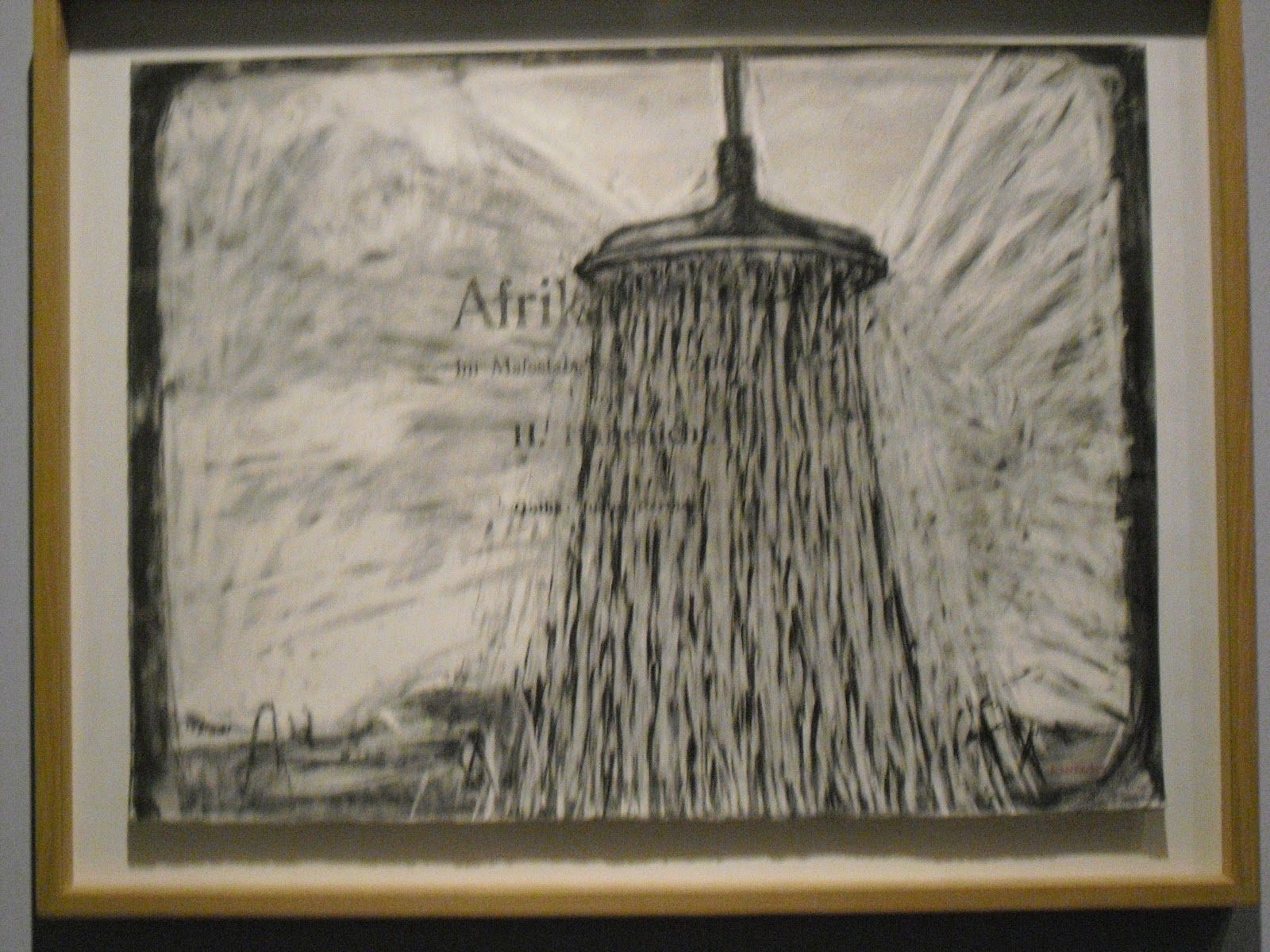
William Kentridge's Black Box at Amsterdam's Jewish Museum

When in Amsterdam... visit William Kentridge's "Black Box". The Amsterdam's Jewish Historical Museum has on display the 'Black Box/Chambre Noire' (2005) and pieces associated with the making of this moving piece of art until 25 November 2012. 


The wonderful piece is expressionist in style in that form alludes to content and vise versa. The medium is multi-media, music, charcoal, theater and puppets.


To understand this art one must be aware of the history of European colonial powers and of Africa's southern region. Black Box tells the story of the Genocide of the Herero and Nama people from 1904 to 1907 in today's Namibia. 

Formally, known as German South West Africa the genocide resulted in over 100 000 people murdered. 75% of the Herero and Nama people were killed and the remainder were placed in concentration camps to work as slave labor.

This genocide has been recognised by the United Nations and the German Republic. To remember the 100 year anniversary Kentridge was commissioned by Deutsche Bank which resulted in the mechanical theatre 'Black Box'.

Kentridge is a South African artist of Jewish heritage. He uses the country's and region's history to socially connect his work to the audience. Kentridge has won numerous artistic awards including the 2009 Association of Art Critics Award. His background in theater and opera is evident in 'Black Box'.

Black Box is a puppet stage. Mechanical puppets move to a backdrop of art that has been created from charcoal and material that Kentridge gathered during research. Kentridge uses the backdrop of Mozart's Magic Flute as a structure but unlike the Magic Flute is not set in 1791 but 1904. The theme of the Magic Flute, the struggle between benevolence and authority, is evident.

Benevolence in 'Black Box' is colonialism and the brotherhood of humankind that European enlightenment developed. The enlightenment is still celebrated today and lays the foundations of western universities. Black Box reminds us that this knowledge developed to a back drop of violence, discrimination and extortion.

Black Box is a piece that can transcend time. The example of the Herero Genocide can be replaced by the Dutch in Indonesia, the English in Kenya or today's killings in the name of state sovereignty. 

For those that question the meaning of modern art Black Box connects you socially through history. The piece is emotional, morals are questioned and beauty realised. Well worth the Admission Price.


Jewish Historical Museum (JHM) in Amsterdam exhibits William Kentridge's work from 16 July until 25 November 2012. The JHM is also teaming up with the Stedelijk Museum Amsterdam to organise an events programme


When in Amsterdam... - Blogged

Amsterdam Jewish Museum Exhibit Avant-garde Husband Wife Painters

When in Amsterdam…visit the Jewish Historical Museum. The museum recently unveiled the first exhibition of Else Berg and Mommie Schwarz. The Avant-garde husband and wife painters were representative of the Dutch modern art scene 1900-1913. They lived in Amsterdam and the Netherlands from 1910 – 1942.
   
Else Berg Self Portrait 1917
Mommie Schwarz Self Portrait 1917


The exhibition, the first of its kind, explores the lives of the two artists through their paintings. The paintings show Berg and Schwarz influence and subjects changing through their paintings during their lives together.The couple met in Berlin in 1908, travelling to Paris before becoming part of the Amsterdam and Bergen art scenes. The Bergen School was a Dutch school of expressionist painters who used cubism with characteristic dark colours.

 In their early art 1900-1913 their paintings were characteristic of this expressionist style with colour and intense hues.

Woman in Red Pinafore- Berg 1913


In 1914 the pair took a trip to Majorca, Spain where their style changed again. Landscapes became composed of entire impressionist colour segments.

Majorca - Else Berg 1914
From 1922-1931 the couple travelled together and apart throughout Europe. They visited Belgium, Czech, Yugoslavia, France and Italy. Berg painted more magical themes while Schwarz depicted more formal issues with his paintings developing strong structure with dark colours, influenced by the Bergen School.

Sardine Fishers - Schwarz 1923


From 1931-1940 Schwarz liked to paint harbour views and fishermen. Berg moved to a style more akin of the populist realist movement of the day with images of ‘people and environment’.

Belagebrug - Schwarz 1936


As Amsterdam became occupied by the Nazi-Germans the couple sent many of their paintings to friends. They returned to Amsterdam in 1942 for an unknown reason and continued painting. Schwarz would paint the view of Sephati Park from their studio window. Painting in dark colours depicting the mood of the time. Berg on the other hand painted children playing care free in the park.


On November 1942 the couple were captured and sent to Westerbork and then onto the infamous Auschwitz concentration camp where they were murdered on their arrival.

The exhibition runs March 23 until June 24. It is a beautiful life story of two artists who shared a passion for each other and for painting.


View of Sarphati Park - Berg 1942
When in Amsterdam....enjoy!

When in Amsterdam... - Blogged